Showing posts with label athletic training. Show all posts

Thursday, 12 December 2019

Sprint Training and Skating Starts

In order to improve performance. all athletes should be focusing their training to specifically enhance motions utilized in their sport or competition. With regards to Short Track Speed Skating, race times are heavily affected by a skaters start. Ice skating sprints starts have a similar motion and acceleration as dry land sprint starts. It is therefore surmised that training dry land starts will benefit on ice starts. Researchers from Australia worked with nine elite and trained short track speed skaters utilizing a four week dry land starts training program to test on ice start improvement.

Athletes completed both dry land and on ice sprints to gain a control number followed by specific sprint start training and then re-doing the dry land and on ice sprints. Figure 3 below shows a comparison of an athlete’s dry land sprint time, to on ice sprint time. Both sprints were measured at time to cross 14.43m. The open circles and dashed line show the results during the control period and the black circles and solid line show the results after specific training.
The results showed a 2.6% increase in on ice sprint time after specific dry land start training.
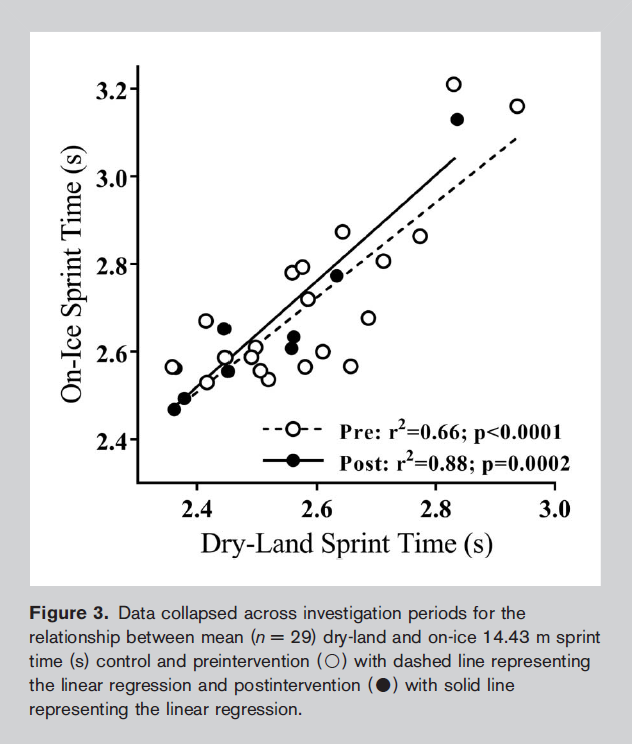

This information can be extrapolated to all athletes. The results show that targeted training of a specific sport mechanic improve results in a game setting. An argument can be made that on ice start training will have equal or better results than dry land start training. While this is likely the case, training in the sport environment, with the right equipment, or having the right number of other athletes is not always possible. In the example of short track speed skating, the athletes likely don’t have ice access during every training session.

The take away for you as an athlete it to work with your coach or personal trainer and determine specific movements and motions you want to improve. Create a training program that you can do anywhere, especially days you don’t have access to play simulation, to target your goals.


References

https://journals.lww.com/nsca-jscr/Fulltext/2019/02000/The_Impact_of_Dry_Land_Sprint_Start_Training_on.30.aspx

Thursday, 5 September 2019

Activating Muscles for Increased Speed

What happens after you use (contract) a muscle? The quick answer is fatigue! Your muscle gets tired and your performance will slowly decrease. However, that is not always the case. Postactivation Potentiation (PAP) is the exact opposite, whereafter contracting a muscle, the same muscle sees an increase in performance. In order to achieve a PAP response, a strength exercise is done at or above 85% of a single repetition maximum weight, after which an increase in power/velocity is seen for 5 - 20 minutes after the strength exercise. How PAP can affect velocity is divided into two types of speed for this review: linear and change of direction.

Linear velocity is moving in a straight line, typically tested as speed in a forward motion. A couple studies have linked performing a back squat to increase sprint speed. Performing a heavy loaded back squat, of 2 sets of 4 repetitions at 85% maximum weight showed an increase in sprint speed by 3% after 4 minutes of rest. Studies using Deadlift and Power Clean did not show any improvement in sprint speed. The reason for this is that the back squat exercise provides a loaded force, pushing into the ground in order to return to standing, which activates the same muscles used to push into the ground while sprinting. It is noted that PAP is linked to individual reaction, and therefore some people may not find the back squat to increase linear speed. In that case, athlete should try unilateral (single leg) exercises that activates either the pushing force of the run or the forward force.

Change of Direction velocity is the speed in which an individual can move in a new direction, typically tested in a full 180° turn. The two studies reviewed involved a back squat followed by a shuttle run, meaning the change of direction was 180°. Performing a heavy loaded back squat, of 5 sets of 1 repetition at 90% maximum weight showed an increase in shuttle run performance of 1.5%. Results from these studies determined less of an increase in Change of Direction velocity versus the studies done with Linear velocity. A reason for this difference could be the more complicated technique of slowing down and turning involved in performing a shuttle run..

In order to use PAP in your training, you first need to test if it will work for you and which exercises. Engage with your coach or a partner and test out different exercises paired with sprinting. In order to avoid fatigue bias in your results, make sure you test each set of exercises 2-3 days apart.


References

https://journals.lww.com/nsca-scj/Fulltext/2018/02000/Effects_of_Postactivation_Potentiation_on_Linear.9.aspx

Friday, 14 June 2019

Pre-Game Training


It’s the day before a game. What kind of training should you be doing to maximize your effectiveness? Are you resting, doing some light movement like yoga or walking, or continuing with your normal scheduled training session? The answer, according to one study, is a low volume power resistance training session!

The study involved 17 national level male athletes tested on countermovement jump (CMJ), reactive strength index (RSI) in the form of a drop jump, and the rate of force development (RFD) for maximum leg press, measured over 100, 200, and 300 seconds. Participants performed two control sessions, testing explosive power before and after 24 hours and 48 hours of rest; as well as two experimental sessions, testing explosive power before and after 24 hours and 48 hours of resistance training. The resistance training was 5 sets of 4 jump squats.

Results showed an improvement in all test exercises after completing the resistance training. Maximum results were seen after 24 hours versus 48 hours from the initial test. The countermovement jump had the lowest increase in performance with only 5% increase in jump height. The reactive strength index, or drop jump had over 10% improvement in drop rate (height x ground contact time). Finally the rate of force development, tested with a leg press saw a large increase in power within the first 100 seconds of the press at an 18% increase, meaning participants were able to push harder in the first 100 seconds of the leg press.

The results 24 hours after the control (resting) sessions had no significant increases in performance, being only 2% or less from the base test.


48 hours after the base test still showed some improvements for the resistance training session. Specifically the rate of force development still had a large increase of 10% in the first 100 seconds.


Additional studies have found similar results, with improvements starting 6 hours post exercise but peaking at 24 hours. It is important to note that many studies found decreased performance with the first 15 to 30 minutes immediately after resistance training. Athletes involved in explosive sports should incorporate a low volume resistance training workout the day before major events. The focus of the training should be related to power type moves, such as a jump squat, focusing on the muscle group that will be primarily used in the sport.


References

https://journals.lww.com/nsca-jscr/Abstract/2018/03000/Delayed_Effects_of_a_Low_Volume,_Power_Type.8.aspx

How to do a Countermovement Jump: https://www.topendsports.com/testing/tests/bosco-counter-movement-jump.htm

How to do a Drop Jump:
https://www.peakendurancesport.com/endurance-training/techniques/drop-depth-jump-plyometric-exercise-increase-vertical-leap-improve-jumping-ability/

Wednesday, 27 March 2019

Single vs Double Leg Jumps


Plyometrics are explosive workouts aimed to improve power and burst force. These types of exercises are typically given to athletes in sports that require quick power or movement. Plyometrics for athletes are used to improve an athlete’s Rate of Force Development (RFD). The RFD is essentially how quickly an athlete can load up (i.e contract) their muscle for use. For explosive power, you are looking at muscle loading taking place within 250 milliseconds.

Previous studies have reviewed strength generated between one leg and both leg activiations. The  findings determined that one legged exercises produced more strength in that leg than the same  exercises done with both legs. These studies were solely done on strength moves and not explosive  moves.

A study was done at the University of Athens to specifically look at explosive power between single  and double leg exercises. The study used 15 physically active participants between the ages of 18  and 26. All participants completed a test on single leg jumping and double legged jumping before and after the study. Participants were split into two groups, one for single leg and one for double leg  exercises. Each group completed 8 exercises twice a week for 6 weeks.

After the 6 week training session the participants all completed the same single leg and double leg  jumps as they did at the start.

Figure 1 shows the initial results for each group and the percent change for each group at the end of the study. The white bars are the bilateral or the double leg group. The black bars are the unilateral or single leg group. The first graph shows the average results for each jump and each group followed by the percent increase for each jump and each group. Both groups saw a similar increase in their double legged jump performance. However, the single leg group saw a 15.6% larger improvement for the single leg jumps on average, which is 5 times more improvement!


Figure 1: Post study testing results


These results can conclude that single leg plyometrics is great for increasing single leg jump  performance as well as double leg jump performance. Double leg plyometrics is great for increasing  double leg jump performance, but less effective at improving single leg jump performance.

A possible explanation for the greater improvement in single leg jumps is due to the nature of the  movement. It has been observed that single leg movements are slower than double leg movements.  The slower speed allows more of the muscle to contract, which leads to a greater force during the  movement. This could explain why the single leg group performed better in the single leg jump test,  since they were training more of the maximum force in their legs.

The take away from this study is that athletes should be incorporating single leg plyometrics in their  training to improve lower body explosive power.


References

Monday, 22 August 2016

My Workout Week


Wonder what I do for my workouts? Here is a breakdown of a week in my workouts, complete with sets and reps!

Monday

Warm Up

20 jumping jacks
20 high knees
20 standing side crunches
10 burpees

Workout - 4 Sets

12 stability ball cross crunches (each side) holding a 20 lb weight
10 V ups
30 sec side plank (each side)
12 stability ball reverse hypers
10 flutter kicks (each leg)
Rest 1 min

Cool Down

A few quick stretches and a protein shake
1.5 hr roller derby practice

Tuesday

1.5 hr roller derby practice

Wednesday

DSC03610.JPGWarm Up

20 jumping jacks
20 high knees
20 butt kicks
12 push ups

Workout - 3 Sets

10 squats holding a 20 lb dumbbells in each hand
10 lunges holding a 20 lb dumbbells in each hand
10 single leg calf raises (each side) holding a 20 lb dumbbell on the same side as the leg being worked
12 clam shells (each side) with a 15 lbs resistance band around my legs
10 hip adductions (each side) with a 30 lb resistance tube
Rest 1 min

Cool Down

A few quick stretches and a protein shake

Thursday

1.5 hr roller derby practice

Friday

Rest day

Saturday

Warm Up

20 jumping jacks
20 high knees
20 butt kicks
10 Burpees

Workout - 3 Sets

12 push ups (from toes)
8 lateral arm raises holding a 8 lb dumbbell in each hand
12 tricep dips from a bench
10 front arm raises holding a 20 lb dumbbell
8 assisted chin ups

Cool Down

A few quick stretches and a protein shake

Sunday

Warm Up - around half a football field

Run
Side shuffle
Backwards run
Grapevine
Grapevine
Run
Side shuffle
Backwards run

Agility Run- 3 Sets

Start facing sides, sprint 5 yards to your left, turn around and sprint 10 yards, turn around and sprint 5 yards back your starting place
Rest 1 min
Repeat heading in the other direction

Plyometrics - 3 Sets

10 hops forward, backwards, right, and left
10 single leg hops (each leg) forward, backwards, right, and left
8 tuck jumps
8 continuous long jumps

Cool Down

Jog around the entire football field


That is a week in my workout! I have a few different core, leg, upper body, and agility workouts I rotate through to ensure a full body workout and to keep things interesting! My husband and I also add in one or two outdoor skating sessions in the summer time.

Friday, 5 August 2016

Weight Training: High vs Low Reps

Let’s talk weight training. If you aren’t doing it, you should! Weight training is an important part of any healthy lifestyle. There are typically two types of weight training people think of: heavy weights with low repetitions or light weights with high repetitions. Which should you be doing to meet your goals? Unfortunately it’s not that clear cut.

Weight lifting can be broken down into three zones: high reps, mid reps, and low reps. Using the below chart, we can talk about what type of weight lifting you should do to meet your goals.
Weight Training Type
Training Effect
Reps per Set
% 1RM
Low Reps
Strength
1-5
80-90
Mid Reps
Hypertrophy
6-12
60-80
High Reps
Endurance
15+
40-60

1RM stands for 1 Repetition Maximum, or the amount of weight you can lift once. It is the basic unit used to determine strength. Here’s an online tool to help you calculate your 1RM (http://www.bodybuilding.com/fun/other7.htm).

First, weightlifting and losing fat. In a previous post, I talked about cardio for fat loss and the link to heart rate. The ideal range of your heart rate to maximize fat loss is 70% - 85% of your maximum heart rate. While that article was about cardio,  The same principle applies to weight training for fat loss as well. How does that translate to high vs low reps? The truth is, it doesn’t matter. The important thing to do is get your heart rate up. My personal suggestion is to do mid to high reps in a circuit of 4-6 moves, taking little to no rest between sets. That being said, the exertion it takes to do heavy weights will also bring your heart rate up. It is harder to maintain a higher heart rate, but the benefit is still there.

Next, what if your goal is to build muscle? It’s commonly thought that lifting heavy weight with low reps is the only way to build muscle.. Studies on the best way to build muscle do not all point to low reps. It seems the most benefit comes from lifting weights until failure or fatigue. So how do you decide which is right for you? It’s going to depend on your experience and time. Doing a low rep workout until failure will be a shorter workout than a high rep workout until failure. The best way to maximize your muscle growth is to mix it up every few weeks. Lift big for a week or two, then switch to low weights.

If your goal is to improve your athletic performance, weight lifting should be an important part of your workout routine. As with cardio, you want to mimic your sport and target the muscles you will be using. If you are in a sport that requires you to be a brick house, like football or rugby, you want to work on muscle growth and strength, so stick to the high weight with low to mid reps. If you are in a long distance endurance sport, such as running or cycling, stick to low weight with high reps. Weight training for endurance sports doesn’t give the body the same simulation as the actual sport itself, but it’s important to have the increased lean muscle to get full power in each stride or push. And lastly, if you are in a power sport that requires you to do quick bursts of action, such as hockey, sprinting or roller derby, you will want to do explosive training. For explosive training, I recommend being in the mid to high reps range, do your movements quickly to simulate the sudden energy you will require in sport.

One last tip. If you are new to weightlifting, start in the high reps range with light weights. Have a friend or a trainer spot you to make sure you are using proper form.

Happy lifting!

References


Monday, 6 June 2016

Cardio for Sports Training

The type of cardio training you want to do to improve sports and athletic performance will vary depending on the sport, your goals, and your fitness. For this article, I will break down the different types of cardio and why you would or wouldn’t want to do them. In general, you want to train to mimic the requirements of your sport.


First to consider is steady state or continuous cardio. Steady state cardio is moving at a constant pace that you can maintain. The pace will be dependant on the duration you are doing. Let’s look at why you would want to do steady state cardio training. The most obvious reason for doing this type of cardio is because you are training for a marathon or another type of event that will require you to move for a long period of time. Steady state cardio is also a great training tool to improve your lung and heart capacity, which is a good base to have for any sport. Additional, this is the type of training you want to do if you are just getting into cardio. Next, let’s look over the reasons why you wouldn’t want to do this type of training. Athletics require a lot of strength and power, as well as endurance and because of this, too much steady state training can actually reduce your strength and power. If you already have a good cardiovascular base and you require bursts of speed and power for your chosen sport, then this training is not for you.

The next type of cardio training is aerobic intervals. Aerobic intervals require doing a movement at a higher intensity followed by a lower intensity. Typically you will go at a higher intensity for 1 - 3 minutes, followed by 1 - 3 minutes at a lower intensity. This type of training is great for any sport that is interval based, where you will be performing for a short period of time, followed by a short rest; hockey is an excellent example. This type of training can also be adapted for non-interval sports by having a longer rest period between high intensity intervals. Interval training helps your body adapt to increases in energy requirements that many sports need. Do not do this type of training if you are just starting out. Work your way up to interval training.


Finally, anaerobic interval training. Anaerobic interval training is doing an activity for a short duration at maximum effort, followed by a long rest. A good example is sprinting for 100m, then resting for 3 to 4 minutes. This training is obviously very good for short distance sprinters, but it can help almost any athlete. In most sports, a short burst of maximum energy is required to get that goal or push yourself into a better position. Anaerobic intervals will help condition your body for these events. This training has the added benefit of working your muscles for power as well. This training is very intense, so definitely do not start with anaerobic intervals. This training has little benefit to long distance runners, or any other sport that requires you to move at a relatively constant pace for a long period of time.


To summarize, all three types of cardio can have a benefit to your athletic improvement, you just need to review your goals and your current physical condition. No matter the cardio type you choose, an important thing to consider is over training! Over training will negatively impact your improvement, and can cause you to become exhausted and under perform during your practices or games. Go over with a trainer the amount and types of exercises you are doing as you might only need to add in 1 cardio session a week.


References